

“A University that
nurtures FAITH,
transforms CHARACTER
and inspires SERVICE!“
A University that nurtures Faith, transforms Character, and inspires Service.
Philippine Christian University is a distinctive Christian institution committed to academic excellence, ethical leadership, human development, and service to society.Transforming Global Learners
A distinctive Christian University integrating faith, character, and service, transforming global learners for enlightenment, leadership, and human development in the 21st century.High Quality Christian Education
Philippine Christian University, an institution related to The United Methodist Church and United Church of Christ in the Philippines, commits itself to deliver high quality education imbued with the formation of Christian character, responsive to the needs of people, and making them responsible leaders and stewards, fostering inter-faith and international goodwill and understanding.Alma Mater, PCU
Fulfilment of our yearning For Christian higher learning, To thee our eyes are turning PCU;
Thy blue and silver banner In firm unchanging manner Is steadied by unshaken loyalty Thine is love of man in service tendered, Thine is love of God in worship rendered, Thine is wholesome growth in Christ engendered, Alma Mater, PCU.A Holistic Christian University
Philippine Christian University is a distinctive institution committed to integrating Faith, Character, and Service in its academic programs. Its vision is to transform global learners into enlightened, ethical, and competent leaders who are equipped to contribute to human development and address the challenges of the 21st century. PCU strives to maintain a dynamic educational environment that fosters critical thinking, leadership, and social responsibility, preparing graduates to make meaningful contributions to society on a global scale.A Legacy of Christian Higher Learning
From its beginnings after World War II to its development as a university, PCU has grown through Christian service, academic expansion, ecumenical partnership, and institutional resilience.The Vision for a Christian School
Bishop Edwin F. Lee of the United Methodist Church sought to establish a Christian school in Manila.Founding of the College
On October 6, 1946, the laymen of the Evangelical Associations of the Philippines founded a college that would later become Philippine Christian University.Articles of Incorporation
The institution was registered with the Securities and Exchange Commission as Manila Union College, later renamed Philippine Christian Colleges.Corporate Governance and Expansion
Dr. Roxy Lefforge became the first Executive Dean. The Union High School of Manila and Union Elementary School became part of Philippine Christian College.Nursing Education Begins
Mary Johnston School of Nursing affiliated with PCC, beginning the offering of a Nursing degree.Ellinwood College Integration
Ellinwood College of Christian Education merged with Philippine Christian College and its curricular efforts were integrated with the programs of the College of Education.University Status
Philippine Christian College acquired university status and became Philippine Christian University.Partnership with Union Theological Seminary
PCU and Union Theological Seminary forged a merger that led to the Philippine Christian Center for Learning and expanded PCU’s offerings in Dasmariñas, Cavite.Globalization and Expansion
PCU became an active participant in the globalization of education through off-campus projects and overseas institutional articulations.Vision Formation and Institutional Development
PCU strengthened programs in curriculum, organization, faculty, and student development, while pursuing a more responsive Vision-Mission direction.Renewed Leadership
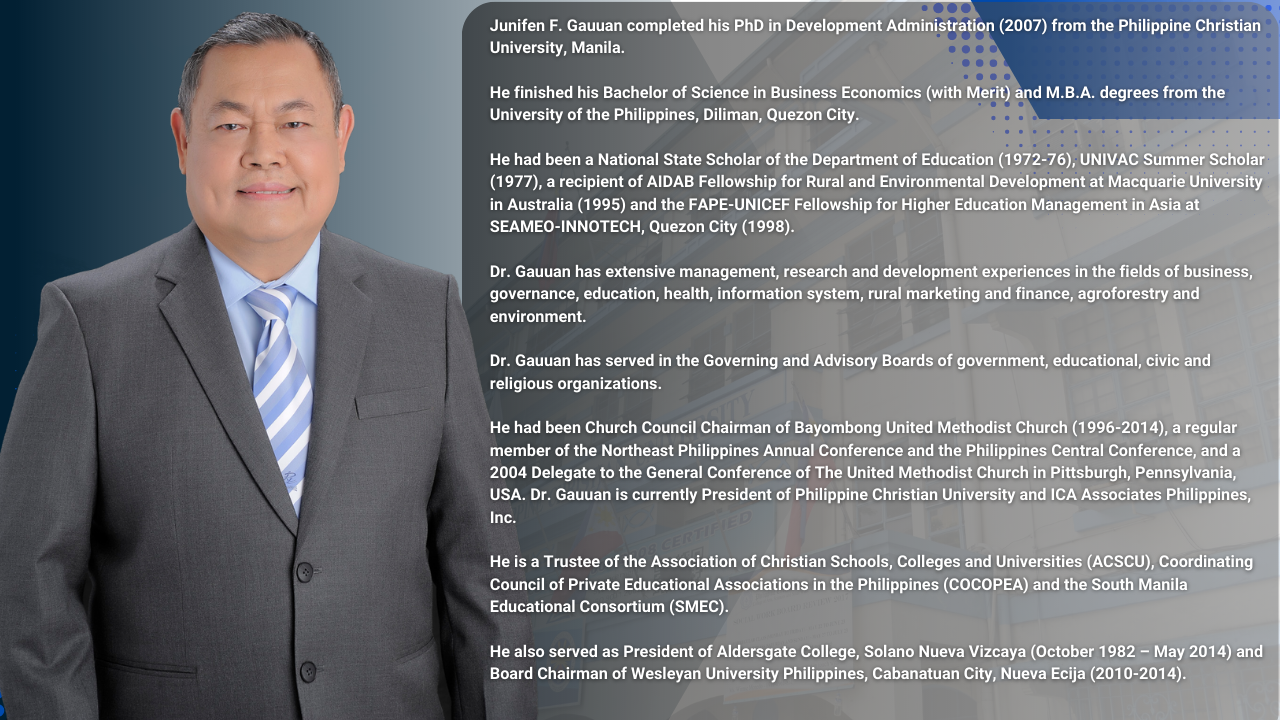
Dr. Junifen F. Gauuan was elected as the seventh President of Philippine Christian University, marking a renewed period of institutional direction.Modern and Global Education
PCU continues to adapt to the challenges and opportunities of a globalized world through modern educational technologies, online learning platforms, and international partnerships.Academic Excellence and Development
PCU’s pursuit of quality education has been reflected in accreditation milestones, institutional recognitions, research activity, and international linkages.Commitment to Learning, Society, and Christian Service
The Philippine Christian Center of Learning embodies a Christian concern for higher education in response to the contemporary demands, challenges, and needs of Philippine life.I. In Relation to the Academic Community and the Academic Vocation
II. In Relation to its Students
III. In Relation to Nature and Society
IV. In Relation to the Global Community
V. In Relation to the Church
Developing Proactive Leaders and Responsible Citizens
PCU aims to:
- Synthesize the teaching of spirituality, religion, and the sciences.
- Inculcate critical and innovative thinking, technological fluency, and multi-cultural skills.
- Provide flexible and innovative programs using online and blended learning methods.
- Offer career choices and pathways through transnational institutions, professional organizations, and linkages.
- Develop proactive leaders, competent workers, and responsible citizens.
PCU is committed to develop graduates who:
- Demonstrate Christian faith.
- Exemplify academic excellence.
- Engage in lifelong learning.
- Practice servant-leadership.
- Exhibit 21st century skills.
- Respond to national and global needs and conditions.
Guided by Faith, Character, and Service
The University regards its human resources as its greatest assets. PCU employees are expected to act truthfully and responsibly with compassion to promote understanding and harmony throughout the institution.God Bless Philippine Christian University.
Philippine Christian University continues to remain a distinctively strong Christian university committed to faith, character, service, and academic excellence.Vision
A distinctive Christian University integrating Faith, Character and Service, transforming global learners for enlightenment, leadership and human development in the 21st Century
Mission
Philippine Christian University, an institution related to The United Methodist Church and United Church of Christ in the Philippines, commits itself to deliver high quality education imbued with the formation of Christian character, responsive to the needs of people, and making them responsible leaders and stewards, fostering inter-faith and international goodwill and understanding.
PCU HYMN
Fulfilment of our yearning
For Christian higher learning,
To thee our eyes are turning PCU;
Thy blue and silver banner
In firm unchanging manner
Is steadied by unshaken loyalty
REFRAIN: (2x)
Thine is love of man in service tendered,
Thine is love of God in worship rendered,
Thine is wholesome growth in Christ engendered, Alma Mater, PCU.
History
In 1945, Bishop Edwin F. Lee of the United Methodist Church (UMC) envisioned a Christian college in Manila. On October 6, 1946, Laymen of the Evangelical Association of the Philippines agreed to the establishment of the college. Their initial Board of Directors Was composed of Atty. Juan Nabong, Sr., Dr. Mateo Occena, Dr. Emilio Javier, Dr. Mauro Baradi, and Mr. Gerardo Armonio.
On January 11, 1947, the Articles of Incorporation was registered with the Securities and Exchange Commission. The original name of the institution was Manila Union University but this was later changed to Philippine Christian College.
Dr. Roxy Lefforge, an American missionary, was the first Executive Dean.
Dr. Emilio Javier (1952-1958), an outstanding layman of the United Church of Christ in the Philippines (UCCP) was elected as the first President. Under his leadership the institution expanded the ecumenical efforts in education. The Union High School of Manila and Union Elementary School founded by the Presbyterian Church in 1919 and 1946 respectively became part of PCC in 1947. The college added a degree course in Nursing when the Mary Johnston School of Nursing, founded by the Methodist in 1907, affiliated with PCC in 1953.
Dr. Juan Nabong, Sr. (1958-1969), a Methodist layman, was the second President. Under his Administration, a four-storey concrete building was constructed in 1960 beside the UTS building on Taft Avenue. A year later, a two-storey building for the Elementary school was constructed in Vasquez Street, Malate. The Ellinwood College of Christian Education was merging with the Philippine Christian College in 1968 and its curricular programs integrated with the programs of the College of Education. Dr. Lino Q. Arquiza (1969-1988), a UCCP Educator, was the third President. Under him, the growth and expansion of PCC was steady and impressive. In 1976, PCC acquired its University status and Philippine Christian University. A highlight of the efforts at cooperation came during Dr. Arquiza’s term when the Union Theological Seminary and PCU merge in 1978. with the merger, the Philippine Christian Center for Learning (PCCL) was born.
The merger enabled PCU to expand its offerings in the 97-hectare UTS campus, 36 kilometers south of Manila.
With this move, Philippine Christian University and Union Theological Seminary, established an ecumenical relationship that is more expansive and more coordinated. Institutional cooperation extended to non-protestant schools when in 1972, PCU and DLSU joined hands in a resource-sharing program. This move ushered in the formation of five-school Inter-Institutional Consortium (I-IC) in 1975 composed of De La Salle University, St. Scholastica’s College, St. Paul’s College of Manila, Philippine Normal College and Philippine Christian University. The Consortium enjoys the full support of the United Board for Christian Higher Education in Asia
With the untimely demise of Dr. Arquiza, PCU had a succession of two able and dedicated Officers-in-Charge in the persons of Justice Crisolito Pascual (1988) and Dean Betty I. Molina (1989).
In 1990, the Board of Trustees elected Dr. Carlito S. Puno (1990-2000), a prominent Methodist lay leader, as the fourth president of the university. The new president of the university provided a new vision and a creative and dynamic leadership for the university. PCU became an active participant in the globalization of education. Under his leadership the university aggressively pursued a program expansion through the off-campus programs and the overseas institutional linkages.
Dr. Oscar S. Suarez, a Princeton University-educated UCCP pastor, became the fifth president of PCU. November 2008 – Appointed a Management Committee comprised of: Atty. Felix D. Carao Jr. (chairperson), retired Justice Wenceslao I. Agnir and Dr. Quintin S. Doromal. December 2013 – Election of Atty. Felix D. Carao Jr. as the 6th president of the University and the reconstitution of the Board of Trustees.
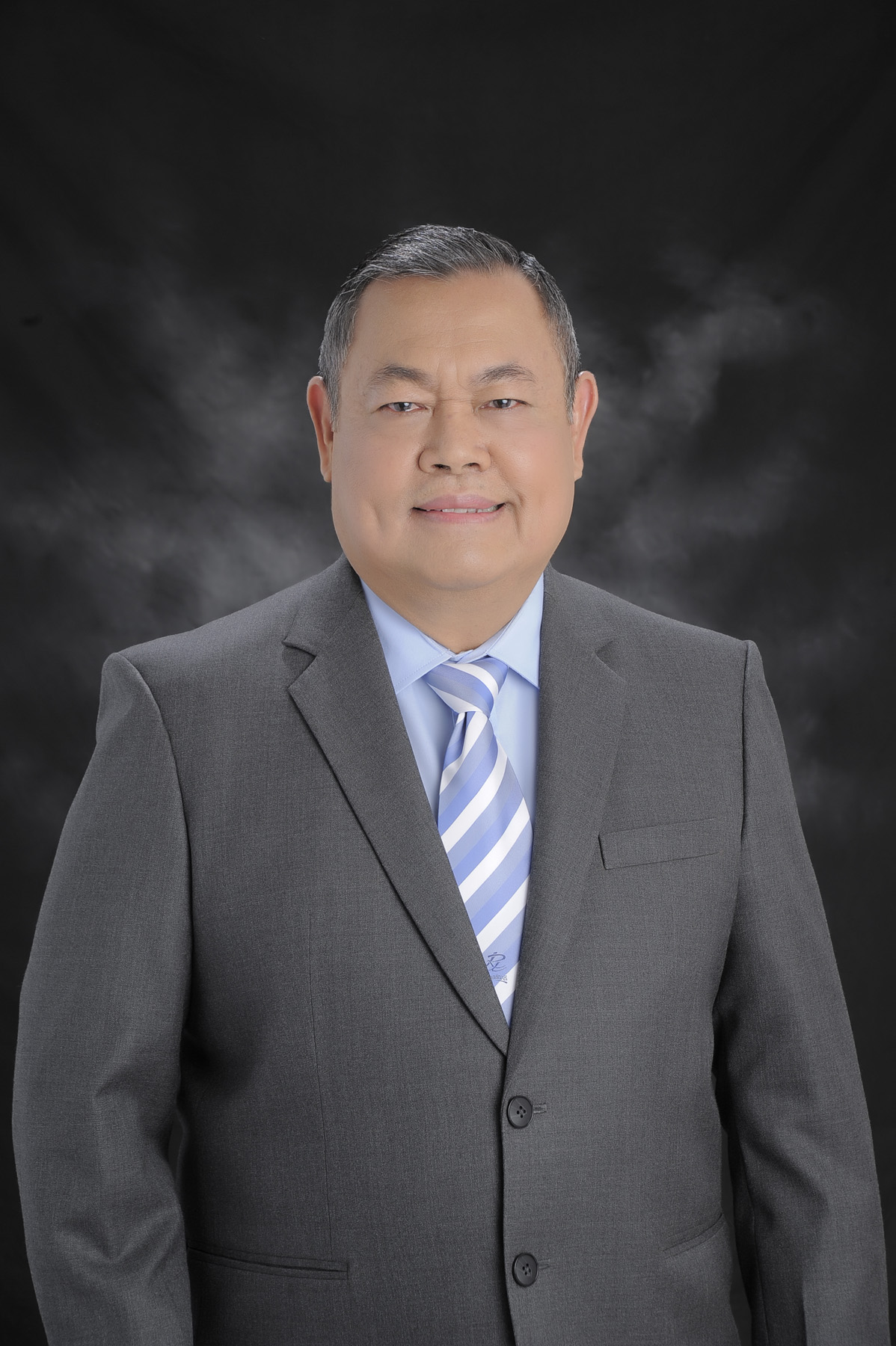
The PCU Board of Trustees elected Dr. Junifen F. Gauuan, a United Methodist layman, as the 7th president of the University. May 2017 – the Commission on Higher Education (CHED) granted Autonomous Status to PCU.
Today PCU had grown into an institution responsive to national needs through its expanded and relevant curricular offerings.